Forest bathing: what the studies measure
Forest bathing produces small, measurable changes within about 15 to 30 minutes: in the largest field experiment, 280 young men in 24 Japanese forests had salivary cortisol 13 to 16 percent lower, pulse rate 4 to 6 percent lower and blood pressure about 2 percent lower after a short walk or sit in the forest than after the same activity in a city. A meta-analysis of 20 trials with 732 participants put systolic blood pressure 3.15 mmHg lower in the forest than in a non-forest setting. The effects are consistent but short-term, mostly measured within 2 hours, and the most recent review grades the certainty of the evidence very low.
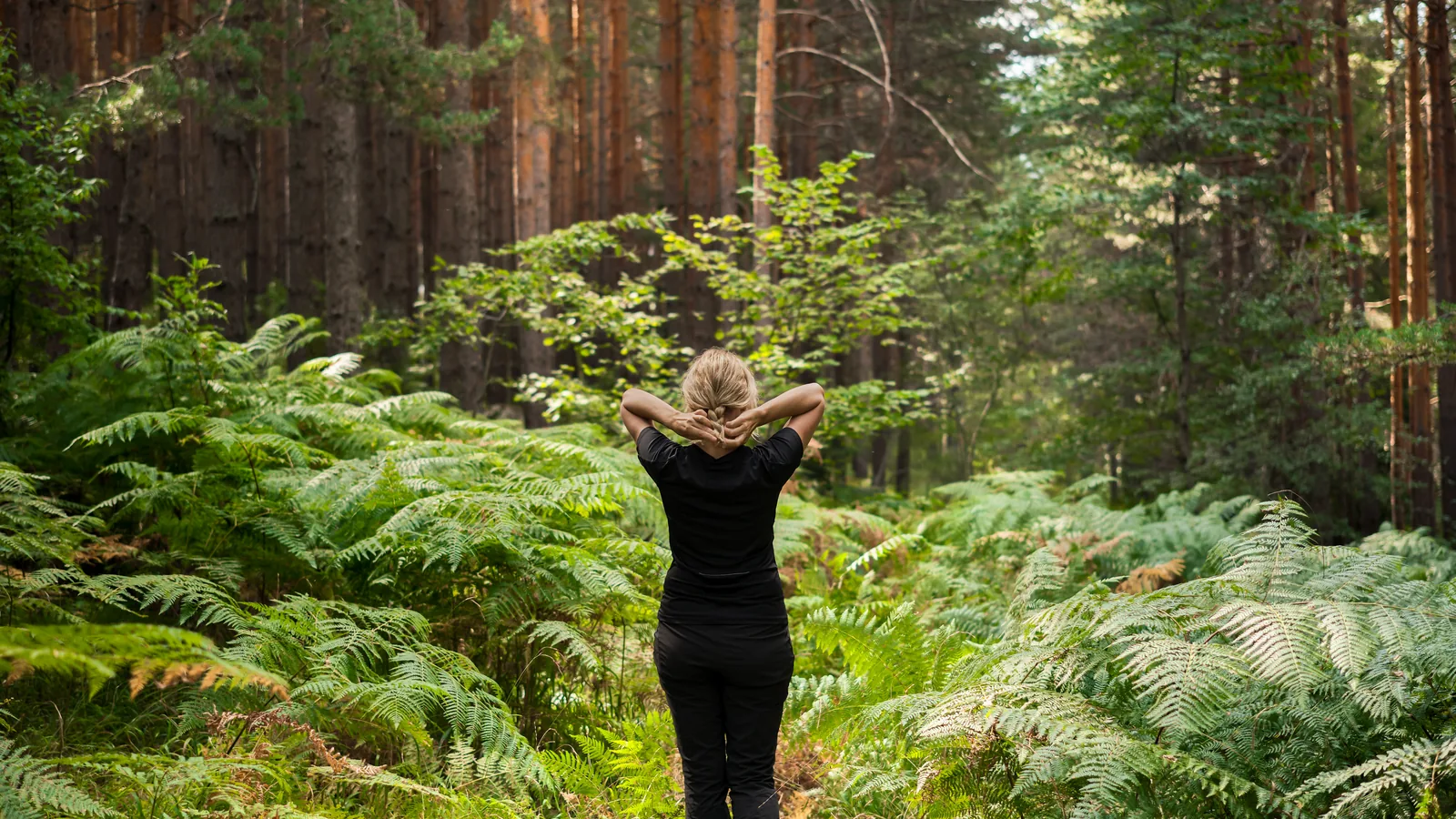
What forest bathing is and what a session looks like
Shinrin-yoku, usually translated as forest bathing, is a term coined by the Japanese Ministry of Agriculture, Forestry and Fisheries in 1982. It means slow, unhurried time in a forest, walking or sitting, without a fitness goal, and the studies are built around that idea rather than around exercise. In the largest set of field experiments, published in 2010 by Park and colleagues, each participant walked for about 16 minutes and then sat and looked at the scenery for about 14 minutes, in a forest one day and a city the next, so each person served as their own control.
That format, 15 to 30 minutes of contact with trees, is typical: in the 2017 meta-analysis of blood pressure trials, 16 of the 20 trials kept the forest exposure within 2 hours and only 2 ran longer than a day. The immune study most people have heard of is not in that review and is far longer, a 3-day, 2-night trip with 2-hour walks.
| Measure | Change in the forest | Evidence | Source |
|---|---|---|---|
| Salivary cortisol | 13.4 percent lower after viewing, 15.8 percent lower after walking | 280 men, 24 forests, forest versus city | Park 2010 |
| Pulse rate | 6.0 percent lower after viewing, 3.9 percent lower after walking | 280 men, 24 forests | Park 2010 |
| Parasympathetic activity (HF of heart rate variability) | 56.1 percent higher after viewing, 102.0 percent higher after walking | 280 men, 24 forests | Park 2010 |
| Systolic blood pressure | 3.15 mmHg lower | 20 trials, 732 participants | Ideno 2017 |
| Diastolic blood pressure | 1.75 mmHg lower | 17 trials, 705 participants | Ideno 2017 |
| Heart or pulse rate | 3.84 beats a minute lower | 13 trials, 563 participants | Ideno 2017 |
| Depression score | Hedges g 1.04 lower, before and after | 16 studies | Kotera 2022 |
| Tension and anxiety (Profile of Mood States) | 0.79 points lower | 11 studies, very low certainty | Andrade 2026 |
| Natural killer cell activity | Higher for more than 7 days after a 3-day trip | Preliminary: 1 study, 12 men aged 35 to 56, no illness outcome | Li 2008 |
Pulse, blood pressure and cortisol in the first half hour
Park and colleagues ran the same protocol in 24 forests across Japan, with 12 participants at each site and 280 in total, all male university students with a mean age of 21.7 years. Compared with the city, salivary cortisol in the forest was 13.4 percent lower after viewing and 15.8 percent lower after walking; pulse rate was 6.0 and 3.9 percent lower; systolic blood pressure 1.7 and 1.9 percent lower; diastolic blood pressure 1.6 and 2.1 percent lower. The high-frequency component of heart rate variability, a marker of parasympathetic activity, was 56.1 percent higher after viewing and 102.0 percent higher after walking, while the ratio that tracks sympathetic activity fell by 18.0 and 19.4 percent.
The blood pressure figures are small, so the 2017 systematic review by Ideno and colleagues is the more useful reference. Pooling 20 trials with 732 participants, it found systolic blood pressure 3.15 mmHg lower in the forest than in a non-forest setting (95 percent confidence interval 2.18 to 4.12), diastolic pressure 1.75 mmHg lower across 17 trials with 705 participants, and heart or pulse rate 3.84 beats a minute lower across 13 trials with 563 participants. The effect was larger where there was more to lower: 6.33 mmHg in the 8 trials whose participants started at a systolic pressure of 130 mmHg or above, against 3.85 mmHg in the 10 trials starting below 130. By group, young men showed 2.53 mmHg, middle-aged or older men 4.27 mmHg and middle-aged or older women 7.16 mmHg, although the last 2 groups together held only 126 people.
For scale, the review cites a Japanese public health estimate that a lasting 4 mmHg fall in average systolic pressure among people aged 40 to 89 would cut deaths from stroke by 8.9 percent in men and 5.8 percent in women. The trials measured only the immediate change; whether a weekly forest visit lowers resting blood pressure over months has not been tested. If you take blood pressure medication, none of this is a reason to change a dose; treat forest bathing as a habit around the treatment, like walking, and see the guide on the two blood pressure numbers for what the figures mean.
Mood, anxiety and depression scores
The mental health evidence is broader but noisier. Kotera, Richardson and Sheffield screened 497 articles for their 2022 systematic review and meta-analysis and included 20 studies, 12 of them randomised controlled trials. Of the 20, 17 were conducted in Asia (10 in Japan, 4 in South Korea, 2 in Taiwan, 1 in China) and 3 in Europe, 2 in Poland and 1 in Serbia. In the before-and-after analyses, depression scores fell by a pooled effect size (Hedges g) of 1.04 across 16 studies, anxiety by 1.83 across 16 studies and anger by 0.81 across 12 studies. In the randomised trials alone, depression fell by 2.54 across 6 studies, but the anxiety estimate from 5 randomised trials had a confidence interval that crossed zero. The authors judged the risk of bias medium to high, found possible publication bias in every analysis except the randomised one for anxiety, and named the missing follow-up assessments as a weakness of the whole field.
A 2026 meta-analysis in Frontiers in Psychology, restricted to 11 studies, reached a similar picture with more caution. On the Profile of Mood States, tension and anxiety fell by 0.79 points, depression by 0.68, anger by 0.39 and fatigue by 1.14, while vigour rose by 0.62; heart rate fell by 4.00 beats a minute. Heterogeneity across the psychological outcomes ranged from 49 to 87 percent, 10 of the 11 studies had no control group, and the authors graded the certainty of every outcome as very low. Their conclusion is the right frame: a complementary practice for wellbeing, not a treatment for a cardiovascular or mental disorder. If you are being treated for depression or anxiety, it sits alongside that treatment, not in place of it.
| Group | Lower in the forest by | Participants | Trials |
|---|---|---|---|
| All participants | 3.15 mmHg | 732 | 20 |
| Starting at 130 mmHg or above | 6.33 mmHg | 136 | 8 |
| Starting below 130 mmHg | 3.85 mmHg | 253 | 10 |
| Young men | 2.53 mmHg | 445 | 8 |
| Middle-aged or older men | 4.27 mmHg | 42 | 4 |
| Middle-aged or older women | 7.16 mmHg | 84 | 4 |
The immune claim and the 12 men behind it
Forest bathing is often sold on its effect on natural killer (NK) cells, white blood cells that attack virus-infected and tumour cells. The source is a 2008 study by Li and colleagues in Tokyo. Twelve healthy men aged 35 to 56 took a 3-day, 2-night trip to forest areas, walking for 2 hours on the first afternoon and for 2 hours in the morning and again in the afternoon of the second day. Blood and urine were sampled during the trip and on days 7 and 30 afterwards, against samples from a normal working day. NK activity and the number of NK cells rose, the cells expressed more of the proteins they use to kill (perforin, granulysin and granzymes), urinary adrenaline fell, and the rise in NK activity lasted more than 7 days. The same men on a city trip with matched activity showed none of these changes. Forest air contained alpha-pinene and beta-pinene, volatile compounds released by trees, almost absent in the city.
Read that as preliminary: 1 study, 12 volunteers, one sex, one age band, no randomisation and a laboratory marker rather than an illness prevented. The phytoncide explanation is a hypothesis the authors themselves call partial, and nobody has shown that people who forest bathe get fewer infections or cancers.
What the evidence cannot tell you
Three limits run through these studies. First, almost everything was measured within hours of the visit, so whether repeated forest bathing changes anything a year later is unanswered. Second, the samples are narrow: 17 of the 20 blood pressure trials came from Japan, 445 of the 732 participants were young men, and 17 of the 20 mental health studies were Asian, with none from Africa, the Americas or Oceania. Third, nobody can be blinded to a forest, so part of what is measured is expectation, and the reviews list that lack of blinding as a main reason for their low certainty ratings.
None of this makes forest bathing pointless; it makes it a low-cost habit with a consistent short-term signal and no established long-term claim. The cautions are the ordinary ones for time outdoors: with heart disease or in pregnancy, keep the pace easy and tell someone where you are; check for ticks afterwards where they carry disease; with hay fever, choose a season or forest type that suits you; and under treatment for high blood pressure, anxiety or depression, forest bathing is an addition, agreed with your doctor if unsure.
How to try it and how often
Copy the studies: a wooded place within 30 minutes of home, 15 minutes of slow walking, then 15 minutes sitting to look, listen and breathe, headphones left at home. Once or twice a week is a reasonable rhythm, and it counts towards the 120 minutes a week in nature from our separate guide. The Nature Dose Planner spreads that time across the week, and the guide on green space and mental health covers what a city park can and cannot do.
A session that matches the studies
- Pick a wooded place you can reach in under 30 minutes
- Walk slowly for about 15 minutes, then sit and look for about 15 minutes
- No headphones and no phone in hand; the trials measured people in quiet
- Go once or twice a week and note how you feel an hour later
- Check for ticks afterwards where they are common
- Keep any blood pressure, anxiety or depression treatment unchanged
Frequently asked
How long does a forest bathing session need to be?
The largest field experiments measured effects after about 16 minutes of walking and 14 minutes of sitting, and 16 of the 20 blood pressure trials in the 2017 meta-analysis kept the forest visit under 2 hours. Half an hour is enough to reproduce what the studies measured.
Do I have to walk, or can I sit?
Both worked in the 24-forest experiments. Sitting and looking at the forest lowered salivary cortisol by 13.4 percent and walking by 15.8 percent compared with the city, and the rise in parasympathetic activity was larger after walking (102.0 percent against 56.1 percent).
Can forest bathing lower my blood pressure?
In the short term, yes, by about 3.15 mmHg systolic across 20 trials, and by 6.33 mmHg in people starting at 130 mmHg or above. The trials measured the effect within hours, so this is not evidence that regular visits lower resting blood pressure over months, and it is not a reason to change medication.
Does forest bathing help with anxiety or depression?
A 2022 meta-analysis of 20 studies found lower depression, anxiety and anger scores immediately after forest bathing, and a 2026 review of 11 studies found the same on mood scales. Both rate the evidence as low quality with no long-term follow-up, so treat it as a supplement to treatment rather than a replacement.
Is the immune system effect real?
It has been measured in a small group: 12 men aged 35 to 56 whose natural killer cell activity rose after a 3-day forest trip and stayed higher for more than 7 days, while a city trip changed nothing. That is a laboratory marker in 12 people, not evidence that forest bathing prevents illness.
Does a city park count as forest bathing?
The trials compared forests with city streets, not with parks, so the numbers above apply to wooded places. A park with mature trees sits somewhere between the two, and the studies have not measured it separately.
Sources
- Park et al. 2010, Environmental Health and Preventive Medicine: The physiological effects of Shinrin-yoku, evidence from field experiments in 24 forests across Japan · 280 male students, 12 per forest, walking 16 minutes and viewing 14 minutes; full text on PubMed Central
- Ideno et al. 2017, BMC Complementary and Alternative Medicine: Blood pressure-lowering effect of Shinrin-yoku, a systematic review and meta-analysis · 20 trials, 732 participants, literature searched to May 2016; full text on PubMed Central
- Kotera, Richardson and Sheffield 2022, International Journal of Mental Health and Addiction: Effects of Shinrin-Yoku (forest bathing) and nature therapy on mental health, a systematic review and meta-analysis · 20 studies including 12 randomised trials; open access at the publisher
- Li et al. 2008, International Journal of Immunopathology and Pharmacology: Visiting a forest, but not a city, increases human natural killer activity and expression of anti-cancer proteins · 12 men aged 35 to 56, 3-day trip, samples on days 7 and 30; abstract on Europe PMC
- Andrade et al. 2026, Frontiers in Psychology: Short-term cardiovascular and mental health responses to Shinrin-Yoku, a systematic review and meta-analysis · 11 studies, 10 of them without a control group, GRADE certainty very low; full text on PubMed Central
Read on
 Nature
120 minutes in nature a week: the threshold and the ceiling
Nature
Green space and mental health: what the numbers say
 Health
Blood pressure: the two numbers explained
Tools that fit
This guide is for general information. It does not replace medical advice or an examination.