Screens in the evening and sleep: what the studies found
Screens in the evening go with less sleep, and the evidence points at the time they take more than at their light. In a 2022 survey of 45,202 Norwegian students, among the 38,809 who used a screen in bed each extra hour after going to bed was linked with 24 minutes less sleep and 59% higher odds of insomnia symptoms. Light adds to it: in a controlled trial, 4 hours on a bright tablet for 5 evenings pushed melatonin onset back by 1.5 hours and cut the evening level by 55%. The NHS advises leaving phones, tablets and computers alone for the hour before bed.
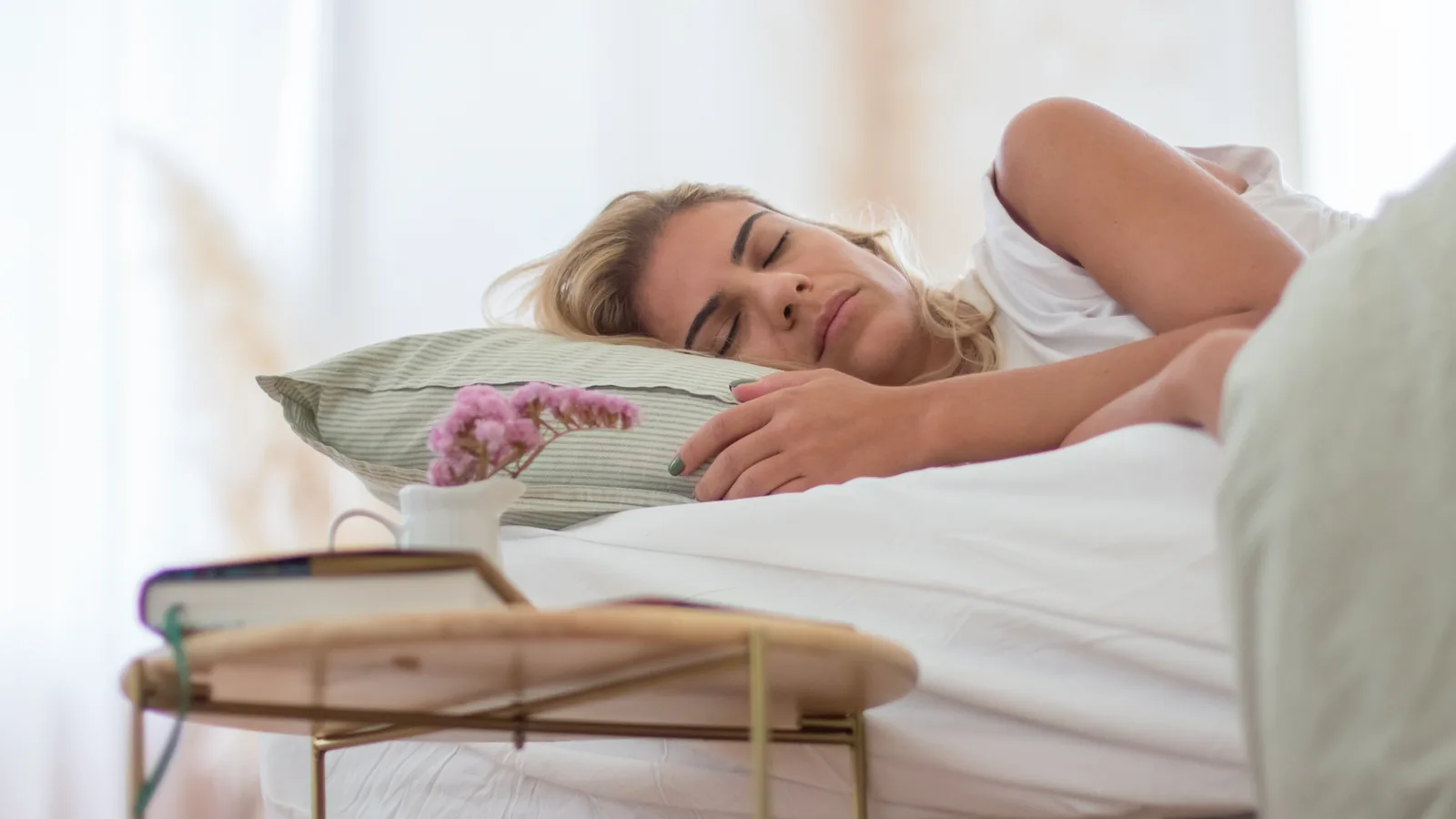
What the NHS advises
The NHS puts a number on it: try not to use phones, tablets or computers for an hour before bed, because the light from screens can make it harder to fall asleep. The advice sits alongside a regular bedtime and wake time, a bedroom that is quiet, dark and cool, and the rule that if you are still awake after about 20 minutes you get up and sit somewhere comfortable.
Lighting scientists have gone further. In 2022 a group of chronobiology and lighting researchers published consensus recommendations in PLOS Biology for healthy adults aged 18 to 55. They measure light in melanopic EDI, a scale weighted for the retinal cells that set the body clock. Their advice: at least 250 melanopic EDI lux at the eye during the day, no more than 10 from 3 hours before bedtime, and no more than 1 while asleep (10 if you need to see your way at night). A screen viewed in an otherwise dark room can deliver more than 60 melanopic EDI lux on its own, which is why the evening target is hard to meet with a phone in your hand.
| Source | Who | Exposure | Finding |
|---|---|---|---|
| Chang et al. 2015, PNAS | 12 adults, average age 25, 14 days in a sleep laboratory | Light-emitting tablet at full brightness, about 31 lux, roughly 4 hours on 5 evenings | Melatonin 55% lower and 1.5 hours later; nearly 10 minutes longer to fall asleep; 12 minutes less REM sleep |
| Chang et al. 2015, PNAS | Same 12 adults, the next morning | Tablet evenings versus printed book evenings | Sleepier on waking; hours longer to feel fully awake |
| Hjetland et al. 2025, Norwegian student survey | 38,809 screen users among 45,202 students aged 18 to 28 | Each hour on a screen after going to bed | 24 minutes less sleep; 59% higher odds of insomnia symptoms |
| Hjetland et al. 2025, Norwegian student survey | 39,809 screen users, by activity | Social media only versus other screen use in bed | Social media users slept 7.76 hours, others 7.38; per hour, no activity was worse than another |
| Carter et al. 2016, JAMA Pediatrics | 125,198 children aged 6 to 19, 20 studies reviewed | Portable device used at bedtime | 2.17 times the odds of too little sleep (7 studies pooled); 2.72 times the odds of daytime sleepiness (2 studies) |
| Carter et al. 2016, JAMA Pediatrics | Same review, 6 studies pooled | Device present in the bedroom, not used | 1.79 times the odds of too little sleep; 2.27 times the odds of daytime sleepiness |
| Brown et al. 2022, PLOS Biology | Expert consensus for adults aged 18 to 55 | Recommended light at the eye | At most 10 melanopic EDI lux from 3 hours before bed; at most 1 during sleep; at least 250 by day |
| NHS | General advice for adults | Phones, tablets and computers | None for 1 hour before bed |
What the laboratory trial showed
The best known experiment on the light side is a 2015 study from Brigham and Women's Hospital in Boston, published in PNAS. Twelve healthy adults, average age 25, lived in a sleep laboratory for 14 days. On 5 consecutive evenings they read from a light-emitting tablet at maximum brightness, about 31 lux at reading distance, for roughly 4 hours between 6 pm and 10 pm; on another 5 evenings they read a printed book, which reflected 0.91 lux. The room was dim in both conditions, about 3 lux. Bedtime and wake time were fixed throughout.
After the tablet evenings, melatonin, the hormone that signals night to the body, began to rise about 1.5 hours later than after the book evenings (22:31 versus 21:01 on average), and the evening level was suppressed by 55%. Participants took nearly 10 minutes longer to fall asleep (about 26 minutes versus 16), had around 12 minutes less REM sleep, felt less sleepy at bedtime and were sleepier the next morning, taking hours longer to feel fully awake.
The design was rigorous but the dose was extreme. Twelve people is a small sample, and the tablet ran at full brightness for 4 hours in a stand 30 to 45 cm from the eyes. The trial proves that screen light can move the clock; it does not tell you how much 20 minutes of messaging at half brightness moves it. The consensus paper also notes a more than 10-fold difference between people in how strongly evening light suppresses melatonin, so your own response may sit far from the average.
What the large surveys found
The other side of the question is time. In 2022 a Norwegian student health survey asked 45,202 students aged 18 to 28 about screens in bed; the analysis was published in 2025. 87.2% used a screen after going to bed, for an average of about 42 minutes a night, and 33.8% reported insomnia symptoms by the DSM-5 definition (trouble falling or staying asleep at least 3 nights a week, daytime tiredness at least 3 days a week, for at least 3 months). Among the 38,809 who used a screen in bed, each extra hour after going to bed was associated with 24 minutes less sleep and 59% higher odds of insomnia symptoms (odds ratio 1.59). Users and non-users slept about the same overall, 7.57 against 7.56 hours, so the gradient sits within the users.
What did not matter was the activity. Students who used only social media in bed slept longest (7.76 hours on average) and had the lowest rate of insomnia symptoms (27.6%), while those who watched, gamed or browsed without social media slept 7.38 hours and had a 37.1% rate. The authors concluded that displacement, screen time simply replacing sleep time, explains most of the association, rather than the content or the light. The survey is cross-sectional and self-reported, with a 35.1% response rate, so it shows association rather than cause, and some poor sleepers reach for a phone because they cannot sleep.
For children the evidence is older and larger. A 2016 meta-analysis in JAMA Pediatrics reviewed 20 studies with 125,198 children and adolescents aged 6 to 19. Using a portable device at bedtime was associated with 2.17 times the odds of inadequate sleep, 1.46 times the odds of poor sleep quality and 2.72 times the odds of excessive daytime sleepiness. A device merely present in the bedroom, without reported use, still went with 1.79 times the odds of inadequate sleep and 2.27 times the odds of daytime sleepiness. The authors rated the evidence low: all were cross-sectional, self-reported, and each pooled odds ratio rests on 2 to 7 studies.
Light or time, which matters more
Screen light is real but it depends on the dose: the tablet trial needed 4 hours at full brightness to shift the clock by 1.5 hours, and the consensus ceiling of 10 melanopic EDI lux applies to the whole room, not to the screen alone. Time is the larger lever. An hour of scrolling in bed is an hour not asleep, and the 24 minutes per hour in the Norwegian survey came from students whose average night was already 7.57 hours, the lower half of the 7 to 9 hours the NHS says adults need.
Night modes and blue light filters address the light strand only, and the consensus paper puts their effect at about a 50% cut in melanopic output, which it calls modest. That figure is a reduction in light, not a measured gain in sleep, and neither trial above tested a filter. A phone at half brightness with the filter on is still a screen in bed, still displacing sleep and still delivering notifications. Dimming helps; stopping helps more. If you keep one rule, keep the NHS hour. Treat the 3 hours of low light in the consensus as a direction rather than a target and dim the room after dinner.
A screen curfew that holds, and when to see a doctor
Most people who try a screen curfew fail at the phone by the bed rather than the phone on the sofa, so start there. Charge it in another room, use a separate alarm clock and set the curfew 60 minutes before the time you want to be asleep, not the time you get into bed. Turn the bedroom light down at the same moment; a dark bedroom is NHS advice too. A printed book, which reflected under 1 lux in the Boston trial, is the closest replacement. The 30-Day Habit Challenge tracks "phone out of the bedroom" and "lights down at 22:00".
Match the curfew to your body clock. A late chronotype who tries to sleep at 22:00 will lie awake with or without a phone; the Chronotype Finder gives you a realistic window, and our guide on morning light covers the other half, since 250 melanopic EDI lux by day makes the evening dose matter less. Caffeine is the other evening habit that overlaps with screens; see when the last cup should be.
Teenagers need more sleep than adults, 8 to 10 hours by the usual guidelines, and the meta-analysis above suggests the device's presence, not just its use, is the problem, so for anyone under 18 the bedroom door is the boundary to hold. See a GP if sleep is still poor after you have changed the habits for a few weeks, if the trouble has gone on for months, or if daytime life is suffering; the NHS offers cognitive behavioural therapy for insomnia and rarely prescribes sleeping pills. If you use a phone at night for a medical reason, such as a glucose monitor, a heart monitor or a baby monitor, keep it, dim it and turn every other notification off.
A 30-day screen curfew
- Set the curfew 60 minutes before the time you want to be asleep, not the time you go to bed
- Charge the phone in another room and use a separate alarm clock
- Dim the room lights at the same time as the curfew; reading light only
- Replace the habit with a printed book, a paper puzzle or a conversation
- If you keep a screen for a medical or family reason, use the lowest brightness and turn other notifications off
- Note bedtime, wake time and how you feel at 3 pm for 14 days before and 14 days after
- If you still lie awake after about 20 minutes, get up, keep the light low and go back when sleepy
Frequently asked
How long before bed should I stop looking at my phone?
The NHS advises not using phones, tablets or computers for an hour before bed. A 2022 expert consensus goes further for light in general, recommending no more than 10 melanopic EDI lux at the eye from 3 hours before bedtime, which in practice means dim room lighting after dinner rather than a 3 hour screen ban.
Does night mode or a blue light filter solve the problem?
Only partly, and the evidence is thinner than the marketing. The 2022 consensus paper puts the reduction from adjusting a screen's colour at about 50% of its melanopic output and calls it modest, which is a change in light rather than a demonstrated gain in sleep. The authors of the Norwegian survey concluded that displaced time, not light, explained most of the association, so a filter does not replace a curfew.
Is an e-reader as bad as a phone?
It depends on the light. In the 2015 PNAS trial a light-emitting tablet at maximum brightness (about 31 lux at reading distance) delayed melatonin by 1.5 hours, while a printed book, reflecting 0.91 lux in the same dim room, did not. A reflective e-ink reader with its front light off or very low is closer to the book than the tablet, although the trial did not test one directly.
Is social media in bed worse than watching a film?
Not in the largest survey. Among 39,809 Norwegian students who used a screen in bed, those who used only social media slept longest (7.76 hours) and had the lowest rate of insomnia symptoms (27.6%), and the association per hour was the same for every activity group. What counted was minutes on the screen after going to bed.
Should a child have a phone in the bedroom overnight?
The evidence says no. In a review of 20 studies covering 125,198 children aged 6 to 19, a device that was present in the bedroom but not reported as used was still associated with 1.79 times the odds of too little sleep and 2.27 times the odds of daytime sleepiness. The studies were observational and cross-sectional, and those two estimates pool 6 studies and 4 studies.
Does watching television in the evening count?
A television across the room usually puts less light on the eye than a phone at 30 to 45 cm, so the light side matters less, though neither trial above measured one. The time side is the same: finishing an episode at 23:40 when you meant to be asleep at 23:00 costs 40 minutes, which is the displacement mechanism the Norwegian survey identified.
Sources
- Chang et al. 2015, PNAS: Evening use of light-emitting eReaders negatively affects sleep, circadian timing, and next-morning alertness · 12 adults, mean age 24.9, 14-day inpatient crossover; about 4 hours on 5 evenings at about 31 photopic lux at reading distance versus 0.91 lux reflected by the printed book, with ambient room light about 3 lux in both conditions; melatonin suppressed 55.12% and onset 1.5 hours later; sleep latency 25.7 versus 15.8 minutes
- Hjetland et al. 2025, Frontiers in Psychiatry (full text at PubMed Central): How and when screens are used, comparing different screen activities and sleep in Norwegian university students · SHOT2022 survey, February to April 2022, 35.1% response rate; the abstract gives n=45,202 aged 18 to 28 and the tables a total of n=45,654, of whom 39,809 (87.2%) used screens in bed; the regression was run on the 38,809 screen users with complete data: odds ratio 1.59 for insomnia symptoms and 24 minutes less sleep per hour; cross-sectional and self-reported
- Carter et al. 2016, JAMA Pediatrics: Association between portable screen-based media device access or use and sleep outcomes, a systematic review and meta-analysis · 20 studies reviewed, all cross-sectional and self-reported, 125,198 children aged 6 to 19; bedtime use odds ratios 2.17 (7 studies), 1.46 (5) and 2.72 (2); device access 1.79 (6), 1.53 (6) and 2.27 (4); evidence graded low
- Brown et al. 2022, PLOS Biology: Recommendations for daytime, evening, and nighttime indoor light exposure to best support physiology, sleep, and wakefulness in healthy adults · Expert consensus, adults aged 18 to 55; melanopic equivalent daylight illuminance (melanopic EDI) at the eye: at least 250 lux by day, at most 10 from 3 hours before bed, at most 1 during sleep; displays alone can exceed 60 lux; spectral adjustment cuts melanopic output by about 50%, which the paper calls modest
- NHS, Every Mind Matters: How to fall asleep faster and sleep better · No phones, tablets or computers for an hour before bed; quiet, dark, cool bedroom; get up after about 20 minutes awake. The page links on to the NHS insomnia advice, which sets out when to see a GP, offers cognitive behavioural therapy and notes that GPs rarely prescribe sleeping pills
Read on
 Health
How much sleep adults really need: 7 to 9 hours, and why
Health
How much sleep adults really need: 7 to 9 hours, and why
 Life
Caffeine: when the last cup should be
Life
Caffeine: when the last cup should be
 Life
Morning light and the body clock: how much you need
Life
Morning light and the body clock: how much you needTools that fit
This guide is for general information. It does not replace medical advice or an examination.