Cold water swimming: benefits, risks and how to start safely
Cold water swimming is manageable for healthy adults who build up gradually, swim in supervised water and never swim alone, and the hazard sits at the start of a swim, not the end: water below 15 °C triggers a cold shock reflex that peaks about 30 seconds after entry and fades over roughly 2 minutes, and this reflex, not hypothermia, causes most immersion deaths; hypothermia needs at least 30 minutes, even in ice-cold water. The benefits are thinner than the enthusiasm suggests: a 2025 meta-analysis of 11 studies and 3,177 people found lower stress 12 hours after immersion, higher inflammation for the first hour, no change in immunity, and a 29% drop in sickness absence in its one large trial.
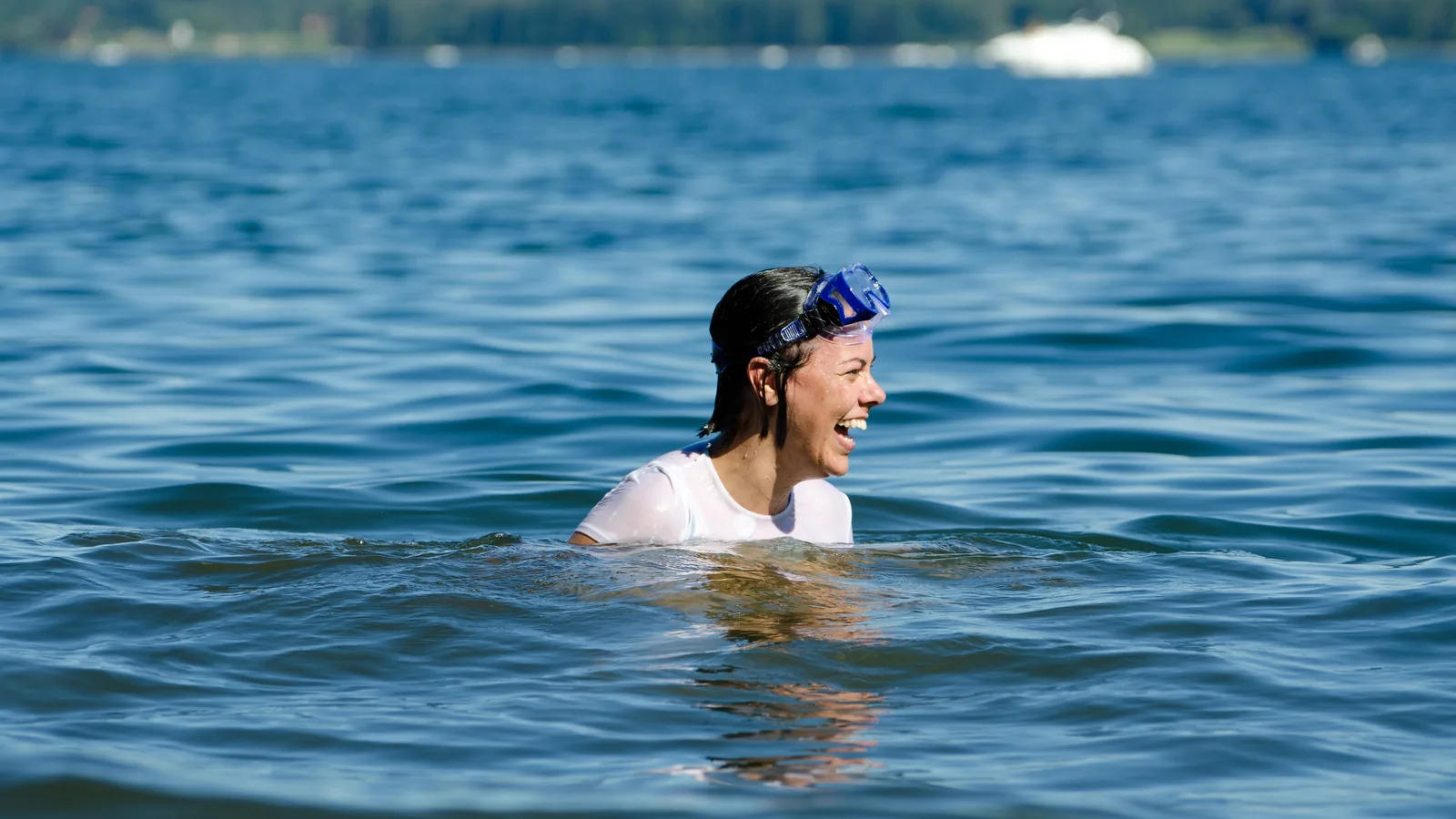
What happens in the first 3 minutes
The first of the four stages of immersion is the killer. In the first 3 minutes, cold receptors in the skin fire a reflex called cold shock: an involuntary gasp, uncontrollable breathing and a sharp rise in heart rate and blood pressure. The 2017 Portsmouth review by Tipton and colleagues reports that the breathing response peaks between 15 and 10 °C and is no stronger at 5 °C, which is why cold water is defined as below 15 °C. A 2020 review by Knechtle and colleagues adds the timing: the peak comes about 30 seconds after entry and fades over roughly 2 minutes.
In that window your breathing is not under your control, and a small volume of inhaled water is enough to start drowning; cold shock causes the majority of immersion deaths. A 1977 UK Home Office report cited in that review found about 55% of open-water deaths within 3 metres of a safe refuge, 42% within 2 metres, and two thirds of the dead regarded as good swimmers. They were incapacitated far faster than whole body cooling can explain.
The counter-move is to do almost nothing. Float to live, the advice of the Royal National Lifeboat Institution, is to fight the instinct to thrash: lean back, tilt your head so your ears are in the water, spread your arms and legs, and float until your breathing is back under control, which the charity puts at about 60 to 90 seconds. Only then shout for help or swim for the bank.
There is a second mechanism. Cold on the body drives the sympathetic nervous system while cold water on the face triggers the opposite, vagal diving response, so the heart gets contradictory instructions at once. Shattock and Tipton named this autonomic conflict in 2012; it can disturb the rhythm even in young, healthy people, especially with a breath-hold. Fatal arrhythmias seem to need a predisposing condition such as long QT syndrome, ischaemic heart disease or a thickened heart muscle, often undiagnosed: in one series they cite, 51 of 64 children with the syndrome developed significant arrhythmias while swimming or diving.
| Water temperature | Response | Note |
|---|---|---|
| About 35 °C | Thermoneutral for a resting, undressed adult; no net cooling | Below this, core temperature falls with time |
| About 25 °C | Thermoneutral for someone exercising; the cold shock reflex can begin here but is easily suppressed | Tipton et al. 2017 |
| Below 15 °C | Definition of cold water; cold shock close to its maximum | Definition from Tipton et al. 1991, used in both reviews |
| 10 to 15 °C | Breathing response at its peak; habituation studies use 12 °C | Six 5-minute immersions reduced the response |
| Below 5 °C | Ice swimming; the reflex is no stronger than at 10 to 15 °C but cooling is faster | The recognised Ice Mile of 1,608 m is swum at 5 °C or below, no wetsuit |
| 0 °C | Water temperature at the 2018 competition death in Russia | Knechtle et al. 2020 |
Swim failure, hypothermia and the afterdrop
From about minute 3 the problem moves to muscles and nerves. Muscle force falls by 4% to 6% for every degree the muscle cools, down to 30 °C, nerve conduction slows below about 20 °C, and a local temperature of 5 to 15 °C for 1 to 15 minutes can block a nerve altogether. Swim failure, when the stroke stops working and the head can no longer be kept clear, arrives long before hypothermia; clumsy fingers, a weak grip and slurred speech are the warnings to get out while you still can.
Hypothermia, a deep body temperature below 35 °C against a normal of about 37 °C, does not develop for at least 30 minutes in an adult, even in ice-cold water; the signs then follow core temperature, from shivering at 36 °C to confusion at 35 °C. Habitual winter swimmers start shivering later, after about 40 minutes of cooling in one study, which is adaptation, not immunity.
The fourth stage is the one recreational swimmers underestimate. About 17% of immersion deaths happen just before, during or soon after rescue, which the Portsmouth review counts as a stage of its own, and core temperature can keep falling once you are out, the afterdrop. The walk to your clothes is part of the swim. If someone is shivering hard, confused or slurring words, call the emergency number, then follow NHS advice for hypothermia: shelter, wet clothing off, a blanket or dry towel, a warm drink and something sugary if the person is fully awake, and no hot bath, hot water bottle, heat lamp or rubbing of the limbs.
What the benefit studies really show
The largest summary of the benefits is a 2025 meta-analysis of 11 randomised trials: 3,177 participants, water at 7 to 15 °C, immersions from 30 seconds to 2 hours. Inflammation rose immediately after immersion (standardised mean difference 1.03) and was still up at 1 hour (1.26). Perceived stress was unchanged immediately, lower at 12 hours (minus 1.00) and back to baseline by 24 hours. Immune measures did not move. One study in men reported better sleep quality (P = 0.04); mood did not differ from passive recovery.
The only large trial in that pool used showers: in 2015, 3,018 Dutch adults aged 18 to 65 ended their shower with 30, 60 or 90 seconds of cold water for 30 days, or showered as usual. Sickness absence fell by 29% in the cold groups (incidence rate ratio 0.71, P = 0.003), with no difference between 30 and 90 seconds, but illness days did not fall and the small quality of life gain had gone by day 90. Of the participants, 79% finished the month and 64% carried on; no serious adverse event was linked to the showers, and every outcome was self-reported.
For swimmers, the two reviews collect smaller, older studies. Winter swimmers had 40% fewer upper respiratory infections than a control group, and 40% of 85 ice swimmers surveyed reported fewer and milder infections, both in self-selected groups. Dopamine, serotonin and beta-endorphin rise after immersion, the likeliest source of the post-swim high. Against that, 8 ice swimmers aged 31 to 71 showed a significant rise in high-sensitivity troponin I, a marker of heart muscle stress, after swims of 500 to 1,000 metres.
| Core temperature | Signs | Note |
|---|---|---|
| 37 °C | Normal | NHS reference value |
| 36 °C | Shivering, fast heart rate and breathing | Winter swimmers shiver later than controls |
| 35 °C | Confusion, disorientation, poor coordination | NHS threshold for hypothermia |
| 34 °C | Amnesia | |
| 33 °C | Cardiac arrhythmias, poor skin perfusion | |
| 30 to 33 °C | Clouding of consciousness, shivering stops, rigid muscles | |
| 28 °C | Ventricular fibrillation, breathing near absent | |
| 25 °C | Cardiac arrest | Reaching this takes far longer than any recreational swim |
How to acclimatise without gambling
Both reviews recommend a step-by-step, graded programme, preferably supervised, that lets the cold shock response habituate before you swim. In one study, six 5-minute immersions in stirred 12 °C water reduced the sympathetic response, and the 2020 review puts basic cold acclimatisation at about 10 days. Swimming on from late summer as the water cools does the same outdoors, and a 30-second cold shower is a fair first step: the shower trial found no advantage in 90 seconds over 30.
On the day, pick a lifeguarded or club-supervised spot, walk in rather than jump, keep your face out and stay within reach of the shore or ladder until your breathing settles, which takes 1 to 2 minutes; only then swim. Keep early swims to a few minutes, well inside the 30-minute hypothermia window, and shorten them as the water cools. Never swim alone, tell someone on shore how long you will be, and dress at once afterwards, hat first.
Talk to a doctor first if you have heart disease, a rhythm disorder such as long QT syndrome, asthma or poorly controlled high blood pressure, and if you are pregnant or under 18. Cold exposure changes insulin sensitivity, so if you take insulin or other glucose-lowering medication, ask how to adjust. People with little body fat cool fastest, so ask as well if you are underweight or recovering from an eating disorder. The 2020 review records two deaths at official ice swimming competitions: an experienced swimmer in Russia in December 2018 after a 50-metre race in 0 °C water, and a 51-year-old in China in December 2019 who had passed the medical check that day. Experience reduces the shock; it does not remove the risk.
What the evidence cannot tell you
The benefit data carry limits the authors state themselves. Of the 11 studies in the 2025 meta-analysis, 6 tested a single immersion and 5 applied cold after exercise; only 1 included women, and the other 10 were 100% male. Winter swimmer surveys compare people who chose the activity and kept it up, so those who felt worse and stopped are missing.
The hazard data are solid: the cold shock response has been measured in laboratories for more than 30 years. For water and green without the shock, the 120 minutes in nature guide and the Nature Dose Planner cover the outdoor evidence.
Before and after a cold swim
- Get a medical check first if you have heart disease, a rhythm disorder, asthma or high blood pressure, take glucose-lowering medication, are pregnant or under 18
- Never swim alone, choose a lifeguarded or club-supervised spot, and make sure someone on shore knows how long you plan to stay in
- If you fall in or panic, float on your back with your ears in the water and your arms and legs spread until your breathing is back under control, about 60 to 90 seconds, then shout for help or swim
- Walk in, keep your face out, breathe out slowly, and stay within reach of the exit for the first 1 to 2 minutes
- Keep early swims to a few minutes and get out while your grip and speech are still normal
- Lay clothes out in order, dress top down with a hat first, drink something warm, and no hot bath or shower while you are still shivering
- Call the emergency number if anyone comes out confused, slurring words or shivering violently, and keep them sheltered, dry and wrapped up until help arrives
- Build up over at least 10 days of graded exposure, starting with 30-second cold showers
Frequently asked
How cold does water have to be to count as cold?
Physiologists define cold water as below 15 °C, because the cold shock response peaks between 15 and 10 °C and is no stronger at 5 °C. Thermoneutral water for a resting adult is about 35 °C, so anything cooler removes heat over time.
Is it dangerous to jump straight in?
Yes. The gasp and uncontrollable breathing reflex peaks about 30 seconds after immersion, and if your head is under water at that moment a small amount of inhaled water is enough to start drowning. Walk in and keep your face out until your breathing settles, usually within 1 to 2 minutes, and if you do fall in, float on your back with your ears in the water until your breathing is back under control, about 60 to 90 seconds, before you try to swim.
Does cold water swimming strengthen the immune system?
The 2025 meta-analysis of 11 studies found no change in immune markers immediately or 1 hour after immersion. Winter swimmers report about 40% fewer respiratory infections and a 3,018-person cold shower trial found 29% less sickness absence, but both rely on self-report.
How long can I stay in?
Hypothermia takes at least 30 minutes to develop in a healthy adult, but swim failure from muscle and nerve cooling comes earlier and varies with temperature, body size and fitness. Beginners should leave after a few minutes, while grip and speech are still normal, and shorten swims as the water cools.
Who should not start without medical advice?
Anyone with heart disease, a rhythm disorder such as long QT syndrome, asthma or poorly controlled high blood pressure, since cold shock raises heart rate and blood pressure sharply and can trigger arrhythmias. Pregnant women, people under 18, anyone taking insulin or other glucose-lowering medication and anyone who is underweight should also ask a doctor first.
Is the afterdrop real?
Yes: core temperature can keep falling after you leave the water, and collapse just before, during or soon after getting out is a distinct stage of immersion that accounts for about 17% of immersion deaths. Dress immediately, hat first, drink something warm, and avoid a hot bath or shower until you have stopped shivering. Call the emergency number if someone becomes confused or starts slurring words.
Sources
- Tipton et al. 2017, Experimental Physiology: Cold water immersion, kill or cure? (University of Portsmouth open access copy) · Four stages of immersion, cold shock peak between 15 and 10 °C, 1977 Home Office data, autonomic conflict, habituation with six 5-minute immersions at 12 °C
- Knechtle et al. 2020, International Journal of Environmental Research and Public Health: Cold water swimming, benefits and risks, a narrative review · Cold shock peak at 30 seconds, muscle force loss per degree, core temperature stages, 40% fewer infections (self-reported), troponin in 8 ice swimmers, competition deaths
- Cain et al. 2025, PLOS ONE: Effects of cold-water immersion on health and wellbeing, a systematic review and meta-analysis · 11 studies, 3,177 participants, water 7 to 15 °C; inflammation, stress, immunity, sleep and quality of life outcomes
- Buijze et al. 2016, PLOS ONE: The effect of cold showering on health and work, a randomized controlled trial · 3,018 Dutch adults, 30 to 90 second cold showers for 30 days, 29% less sickness absence, 79% adherence, self-reported outcomes
- NHS: Hypothermia · Definition below 35 °C, signs, first aid steps and what not to do
Read on
 Nature
120 minutes in nature a week: the threshold and the ceiling
Nature
120 minutes in nature a week: the threshold and the ceiling
 Nature
Forest bathing: what the studies measure
Nature
Forest bathing: what the studies measure
 Health
Resting heart rate: what the number says
Health
Resting heart rate: what the number saysTools that fit
This guide is for general information. It does not replace medical advice or an examination.