Strength training after 40: how much is enough
The guideline dose does not change at 40, and it does not change at 65: the World Health Organization's 2020 guidelines ask every adult for muscle-strengthening work covering all major muscle groups at moderate or greater intensity on 2 or more days a week, with balance and strength work on 3 or more days added from 65. Muscle mass falls by roughly 3 to 8 percent per decade after 30 and faster after 60. In 7 cohort studies pooled in 2022, adults who did any muscle-strengthening activity had a death rate 15 percent below those who did none, lowest at about 40 minutes a week, on evidence graded very low in certainty.
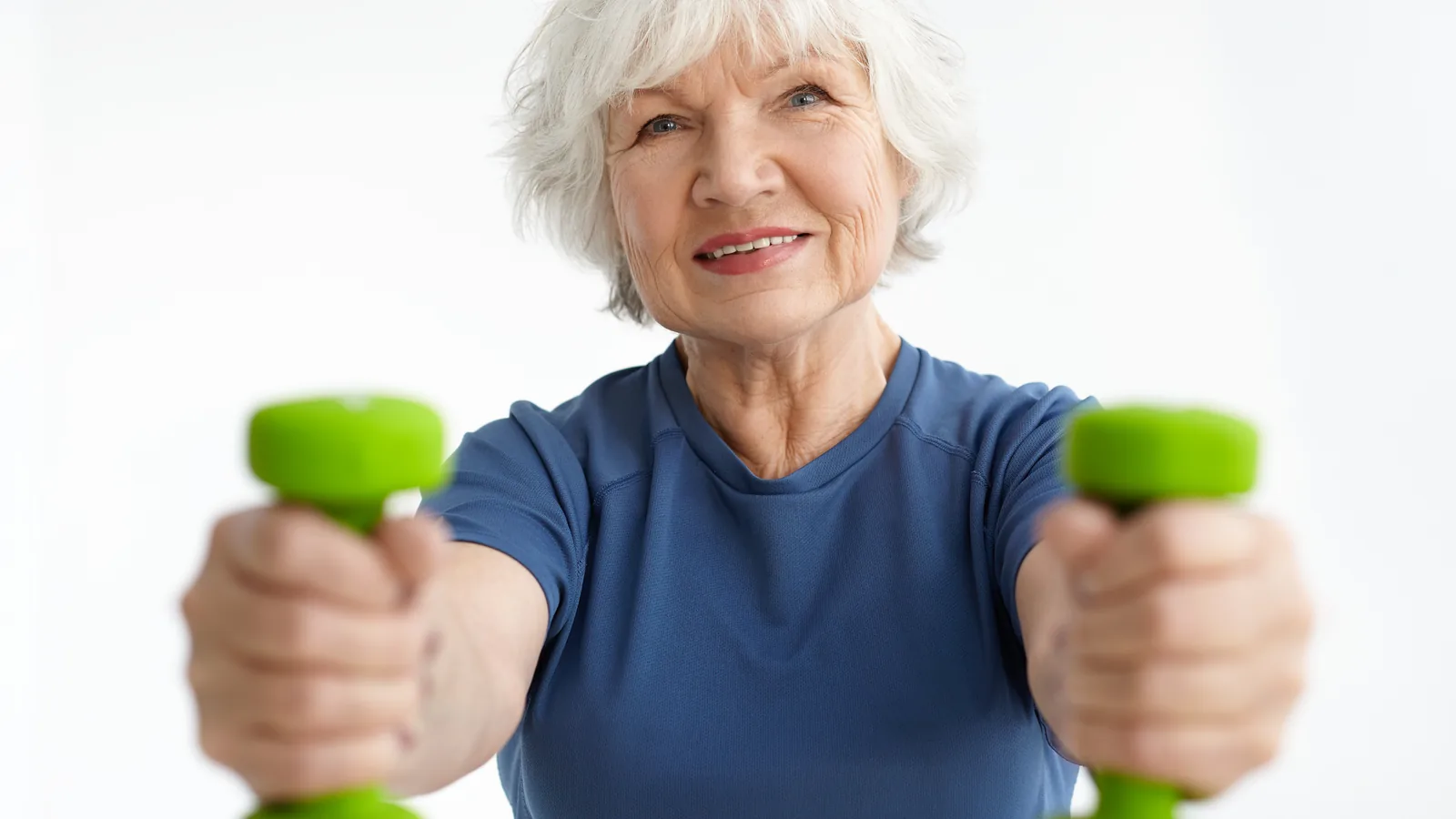
What happens to muscle after 40
Muscle shrinks long before anything feels wrong. The review by Volpi, Nazemi and Fujita in Current Opinion in Clinical Nutrition and Metabolic Care puts the loss at approximately 3 to 8 percent of muscle mass per decade after the age of 30, with a steeper decline after 60. It also traces part of the reduction of around 30 percent in the ability to use oxygen during exercise (VO2 max) seen in older people to changes inside the muscle cell.
The changes it lists are structural: fewer muscle cells, fat inside and around the muscle, a lower nerve firing rate and fewer motor neurons. Force falls with the mass, which is why grip strength and walking speed serve as markers of ageing; see the guides on grip strength and walking speed.
None of this is fixed: the same review reports that progressive resistance exercise builds muscle and strength even in elderly and physically frail adults. On protein it is cautious. Older people may need around 1 gram per kilogram of body weight a day, above the 0.8 grams per kilogram set by the United States Institute of Medicine, but supplements and high-protein diets have largely failed to add muscle, and protein added to resistance exercise did not beat exercise alone in the studies reviewed. In that 2004 review the training carries the effect.
| Weekly dose | What the evidence attaches to it | Source |
|---|---|---|
| None | Reference group; 7 of the 16 studies supplied the mortality comparison | Momma 2022 |
| About 30 minutes | Lowest total cancer risk, 9 percent below none, from 4 studies | Momma 2022 |
| About 40 minutes | Lowest all-cause mortality, 17 percent below none, from 6 studies | Momma 2022 |
| About 60 minutes | Lowest cardiovascular risk, 18 percent below none; diabetes risk falls sharply up to this point | Momma 2022 |
| About 130 to 140 minutes and above | Pooled estimate no longer below the no-activity group and rising again, on very low certainty evidence | Momma 2022 |
| 2 or more days, all major muscle groups | Recommendation for every adult from 18, including those aged 65 and over | WHO 2020 |
| 3 or more days of balance and strength work | Added from age 65 on top of the 2 days, to keep function and prevent falls | WHO 2020 |
| 2 to 3 sessions a week for 8 to 12 weeks | Typical trial programme: large strength gains, walking speed up 0.08 metres a second | Cochrane 2009 |
How much the guidelines ask for
The World Health Organization's 2020 guidelines give adults aged 18 to 64 two targets. The first is 150 to 300 minutes a week of moderate-intensity aerobic activity, or 75 to 150 minutes of vigorous activity, or an equivalent mix. The second is muscle-strengthening activity at moderate or greater intensity involving all the major muscle groups on 2 or more days a week, a strong recommendation on moderate-certainty evidence, and the one most people miss.
The 2 days do not stop at 65. The older adult section is written as the adult recommendations plus one addition, so the aerobic minutes and the 2 or more days of muscle strengthening still stand, and on top of them older adults should do varied multicomponent activity emphasising functional balance and strength training at moderate or greater intensity on 3 or more days a week, to keep functional capacity and prevent falls. Read as a jump from 2 days to 3, it loses the balance work.
WHO does not define moderate or greater intensity in repetitions, sets or kilograms, so a rep scheme from one country's health service is guidance for that country, not a global rule. The guideline defines coverage: legs, hips, back, abdomen, chest, shoulders and arms.
What 30 to 60 minutes a week is associated with
The largest pooled analysis is the 2022 meta-analysis by Momma and colleagues in the British Journal of Sports Medicine, which screened 16 prospective cohort studies, sizes from 3,809 to 479,856 people, ages 18 to 97, maximum follow-up 25.2 years, most from the United States. Each outcome rests on a subset of those 16. Against people who did none, those who did some had a 15 percent lower rate of death from any cause (7 studies, 263,058 people), 17 percent for cardiovascular disease (7 studies), 12 percent for total cancer (6 studies), 17 percent for diabetes (5 studies) and 10 percent for lung cancer, from only 2 studies.
All of those percentages are relative. A 15 percent lower rate of death means 15 percent below the death rate of people who did none, not 15 deaths avoided per 100 people, and in a middle-aged population the absolute difference over a decade is small. The review graded its own evidence very low in certainty for mortality, cardiovascular disease and cancer, and low for diabetes.
The dose-response curves rest on fewer studies still: 6 for mortality, 5 for cardiovascular disease, 4 for total cancer, 3 for diabetes. For all-cause mortality the curve was J-shaped, the lowest risk 17 percent below non-participants at about 40 minutes a week, and the pooled estimate stayed under the no-activity group only up to roughly 140 minutes a week, rising back above it beyond that. Cardiovascular disease was lowest at 60 minutes (18 percent below) and crossed back near 130, total cancer lowest at 30 minutes (9 percent below) and crossed back near 130 as well. Only diabetes kept improving, on an L-shaped curve that fell sharply up to 60 minutes and then flattened.
That upward arm is not evidence of harm: the trend per 10 extra minutes was small and not significant for cardiovascular disease (p 0.26) or total cancer (p 0.15), every study measured training by questionnaire or interview, and the authors call the influence of higher volumes unclear. What it undercuts is the idea that more is reliably better. People reporting both strength and aerobic activity did best: 40 percent lower all-cause mortality, 46 percent lower cardiovascular disease and 28 percent lower cancer mortality than those who did neither.
| Outcome | Change | Evidence |
|---|---|---|
| Leg press strength | Plus 29 percent | Peterson 2010, 47 studies, 1,079 participants, mean 17.6 weeks |
| Knee extension strength | Plus 33 percent | Peterson 2010 |
| Chest press strength | Plus 24 percent | Peterson 2010 |
| Lat pull strength | Plus 25 percent | Peterson 2010 |
| Walking speed | Plus 0.08 metres a second | Cochrane 2009, 24 trials, 1,179 participants |
| Rising from a chair | Moderate to large improvement | Cochrane 2009, 11 trials, 384 participants |
| Osteoarthritis pain | Small reduction | Cochrane 2009, 6 trials, 503 participants |
| Bodily pain in general | No effect detected | Cochrane 2009, 10 trials, 587 participants |
How much stronger you can expect to get
Peterson and colleagues pooled 47 studies with 1,079 participants aged 50 to 92 (mean 67.4 years) in 2010. Programmes ran 6 to 52 weeks, on average 17.6, at 2.7 sessions a week, 8.3 exercises, 2.5 sets per exercise, about 10 repetitions per set and loads averaging 70 percent of the one-repetition maximum. Strength rose 29 percent on the leg press, 33 percent on the knee extension, 24 percent on the chest press and 25 percent on the lat pull, or 9.8 to 31.6 kilograms, and higher intensity predicted larger gains.
The 2009 Cochrane review by Liu and Latham is broader: 121 randomised trials with 6,700 older participants, training 2 to 3 times a week in almost all of them, at high intensity in 83 trials, 71 programmes lasting 8 to 12 weeks. The effect on strength was large, a standardised mean difference of 0.84 across 73 trials with 3,059 participants. Walking speed rose by 0.08 metres a second across 24 trials with 1,179 participants, getting out of a chair improved across 11 trials, and osteoarthritis pain fell across 6 trials with 503 participants. Bodily pain in general did not shift in 10 trials with 587 participants.
The reviewers were careful about safety. Serious adverse events were rare and none was reported as directly related to the training, but adverse events were poorly recorded, joint pain and soreness were common where they were monitored, and the review says the evidence was insufficient to comment on the risks or the long-term effects. Participants were mostly in their sixties and seventies and 20 trials averaged 80 or over, so 40 or 50 is early, and gains arrived within 8 to 18 weeks.
A starting plan and when to check with a doctor
A first programme that meets the WHO dose and matches what the trials did is modest: 2 sessions a week on non-consecutive days, 6 to 8 exercises covering legs, hips, trunk, back, chest, shoulders and arms, 2 sets of about 10 repetitions each, rising to 3 sets after a few weeks. Choose a load at which the last 2 repetitions are hard but your form stays clean, near the 70 percent of a one-repetition maximum used in the trials, and add a small increment when they feel easy in 2 consecutive sessions. Breathe out on the effort and never hold your breath, which pushes blood pressure up sharply. Each session takes 20 to 30 minutes, which lands you in the 30 to 60 minutes a week where the cohort curves were lowest. The protein by age guide and the Protein and Fibre Target tool turn 1 gram per kilogram into a daily number.
Some situations call for a doctor's advice first. With heart disease, uncontrolled high blood pressure or blood pressure medication, ask about safe loads and about breath-holding. If you use insulin or other glucose-lowering drugs, strength training can lower blood glucose for hours afterwards, so discuss monitoring and dose timing. Recent surgery of any kind, a hernia or hernia repair, osteoporosis, a joint replacement and diabetic eye disease each change what is safe to lift, and heavy loads are usually postponed for weeks after an operation. In pregnancy ask your midwife or doctor: straining against a held breath, very heavy loads and lying flat on the back in the later months are generally advised against. With kidney disease, ask before raising protein towards 1 gram per kilogram, because targets are set differently when kidney function is impaired. Stop and seek help for chest pain, dizziness, sudden breathlessness or sharp joint pain that does not settle.
A first month of strength training
- Pick 6 to 8 exercises that cover legs, hips, trunk, back, chest, shoulders and arms
- Train on 2 days a week with at least 1 rest day between sessions
- Do about 10 repetitions per set, the average in the pooled trials, 2 sets at first and 3 after a few weeks
- Choose a weight at which the last 2 repetitions are hard but the form stays clean
- When those last repetitions feel easy in 2 sessions running, raise the weight a little
- Breathe out on the effort; never hold your breath under load
- Spread protein across meals; older adults may need around 1 gram per kilogram a day, though added protein did not improve on training alone in the studies reviewed
- Add balance work from 65, keeping the 2 strength days, or earlier if you have had a fall
Frequently asked
Is it too late to start strength training at 50 or 60?
No. In a meta-analysis of 47 trials, participants with a mean age of 67.4 years gained 24 to 33 percent in strength over an average of 17.6 weeks, and 20 of the 121 trials in the Cochrane review had an average age of 80 or over.
Do I need a gym?
Not necessarily. The trials used exercise machines, free weights and elastic bands, and what mattered was the load: programmes averaged 70 percent of a one-repetition maximum, and higher intensity predicted larger gains. Bodyweight work counts as long as it stays hard enough as you get stronger.
How many minutes a week do I need?
The WHO guideline sets days, not minutes: 2 or more days a week covering all major muscle groups, at every adult age. The 30 to 60 minutes a week at which risk was lowest comes from dose-response curves built on only 3 to 6 cohort studies per outcome, and 2 sessions of 20 to 30 minutes cover it anyway.
Is more strength training always better?
The cohort data says no. The pooled estimate for all-cause mortality was lowest at about 40 minutes a week and stopped sitting below the no-activity group at roughly 140 minutes, rising above it beyond that, and the same J shape appeared for cardiovascular disease and cancer near 130 minutes. The authors call the effect of higher volumes unclear rather than harmful, on evidence of very low certainty.
Is it safe with high blood pressure or heart disease?
Ask your doctor first, especially if your blood pressure is not yet controlled. Avoid holding your breath during a lift, and stop for chest pain, dizziness or sudden breathlessness. Across 121 randomised trials in older adults serious adverse events were rare, but the reviewers noted that adverse events were poorly recorded and that the evidence on risk was insufficient.
Does walking count as strength training?
No. Walking counts towards the 150 to 300 aerobic minutes in the WHO guidelines, while strength work needs a load heavy enough that the last repetitions of a set are hard. People who reported both kinds of activity had 40 percent lower all-cause mortality than those who did neither, so the two are complementary, not interchangeable.
Sources
- Bull et al. 2020, British Journal of Sports Medicine: World Health Organization 2020 guidelines on physical activity and sedentary behaviour · Muscle strengthening on 2 or more days a week for all adults, strong recommendation on moderate-certainty evidence; older adults, as for adults plus multicomponent balance and strength training on 3 or more days; full text on PubMed Central
- Momma et al. 2022, British Journal of Sports Medicine: Muscle-strengthening activities are associated with lower risk and mortality in major non-communicable diseases, a systematic review and meta-analysis of cohort studies · 16 cohort studies, 7 of them for mortality; J-shaped dose-response curves from 3 to 6 studies each; self-reported activity; certainty graded very low; full text on PubMed Central
- Volpi, Nazemi and Fujita 2004, Current Opinion in Clinical Nutrition and Metabolic Care: Muscle tissue changes with aging · 3 to 8 percent of muscle mass per decade after 30; protein need may be around 1 gram per kilogram a day; supplements added to exercise did not beat exercise alone; author manuscript on PubMed Central
- Liu and Latham 2009, Cochrane Database of Systematic Reviews: Progressive resistance strength training for improving physical function in older adults · 121 randomised trials, 6,700 participants; serious adverse events rare but adverse events poorly recorded; author manuscript on PubMed Central
- Peterson et al. 2010, Ageing Research Reviews: Resistance exercise for muscular strength in older adults, a meta-analysis · 47 studies, 1,079 participants aged 50 to 92; mean 70 percent of one-repetition maximum, about 10 repetitions per set; author manuscript on PubMed Central
Read on
 Longevity
Grip strength: the ageing marker in your hand
Longevity
Grip strength: the ageing marker in your hand
 Food
Protein by age: how much you need at each stage
Food
Protein by age: how much you need at each stage
 Health
How many steps a day: what the studies support
Health
How many steps a day: what the studies supportTools that fit
This guide is for general information. It does not replace medical advice or an examination.