The Mediterranean diet: what the evidence says
It is the best-tested eating pattern for the heart, and the gains are real but modest. In the PREDIMED trial, 7,447 Spanish adults aged 55 to 80 at high cardiovascular risk who were assigned a Mediterranean diet with extra-virgin olive oil or nuts had about 30 percent lower risk of a heart attack, stroke or cardiovascular death over a median of 4.8 years than a reduced-fat control group (adjusted hazard ratios 0.69 and 0.72), which comes to roughly 1 event fewer per 100 people. In a cohort of 25,315 US women followed for 24.7 years, the highest adherence went with 23 percent lower all-cause mortality, 11 percent once other habits were counted, while a 2019 Cochrane review of 30 trials with 12,461 participants rated most of the evidence low to moderate quality and found little or no effect on death from any cause.
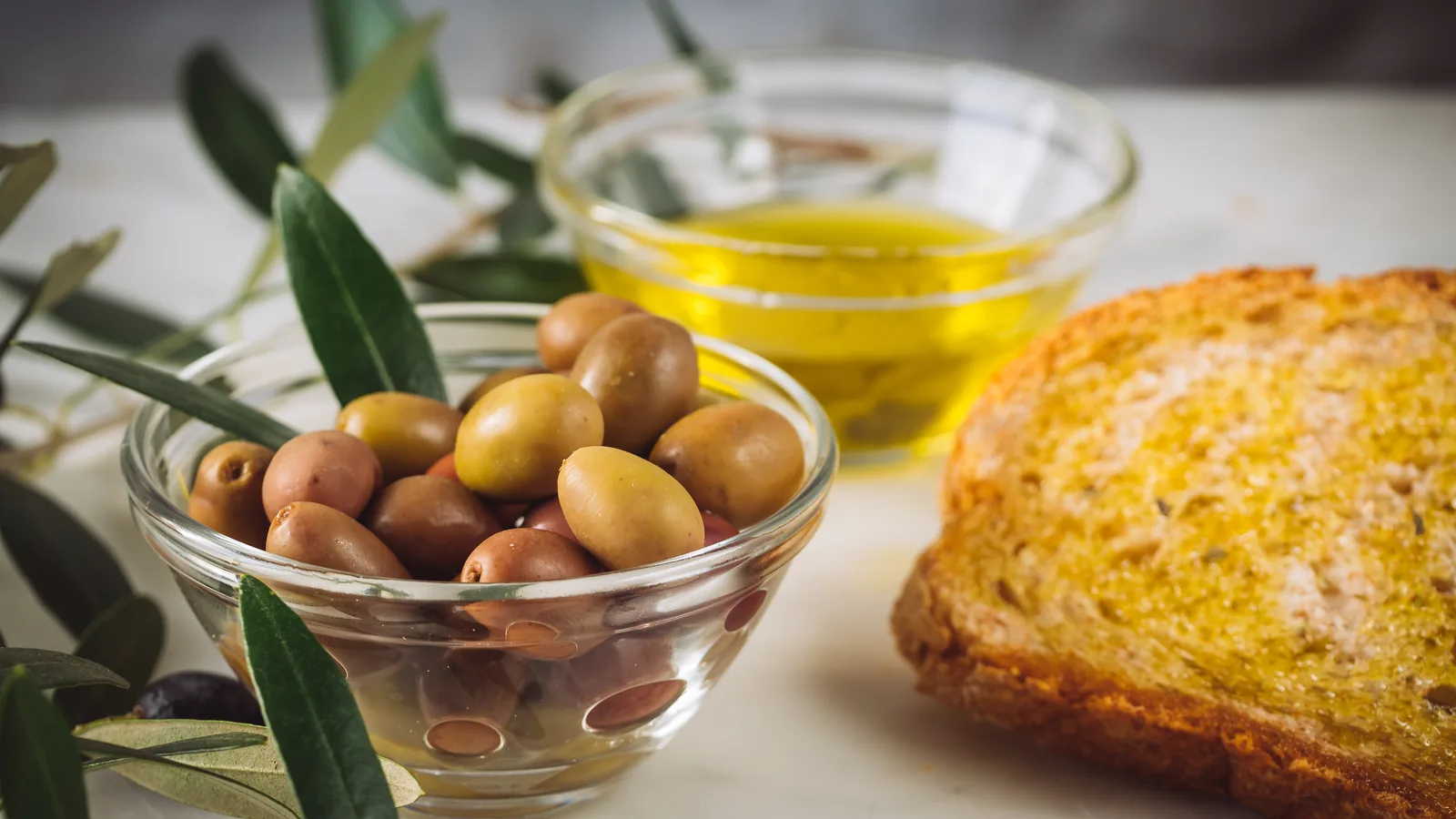
What the studies mean by a Mediterranean diet
Definitions vary, but the 2019 Cochrane review required both a high ratio of monounsaturated to saturated fat, in practice olive oil as the main cooking fat and often nuts, and a high intake of plant foods: fruit, vegetables and legumes. Whole grains, fish in place of meat and moderate dairy counted as additional components.
The PREDIMED trial used a 14-item screener. In a 2012 analysis of the 7,447 trial participants (55 to 80 years old, 57 percent women), each item earned 1 point, from olive oil as the main fat to a tomato, onion and garlic sauce cooked in it twice a week. The table below sets out 13 of the 14; the one left out asks about a drink this guide does not cover. There, every 2 extra points went with a waist 0.92 cm smaller in women and 0.93 cm smaller in men, a cross-sectional association, not a result of the diet. The 2024 Women's Health Study analysis used a simpler 9-point score, and its median participant scored only 4.
| Food | Target for the point | Points |
|---|---|---|
| Olive oil | Main cooking fat, at least 4 tablespoons a day, and a tomato and onion sauce cooked in it 2 or more times a week | 3 |
| Vegetables | 2 or more servings a day, at least 1 of them raw or as salad | 1 |
| Fruit | 3 or more pieces a day | 1 |
| Legumes | 3 or more servings a week | 1 |
| Fish or shellfish | 3 or more servings a week | 1 |
| Nuts | 3 or more servings a week | 1 |
| Red and processed meat | Fewer than 1 serving a day, and poultry chosen over red meat | 2 |
| Butter, margarine, cream | Fewer than 1 serving a day | 1 |
| Sweet drinks and pastries | Fewer than 1 sweet or fizzy drink a day, fewer than 3 commercial pastries a week | 2 |
The one large trial and what it measured
Most of what is claimed for the diet rests on PREDIMED, a multicentre Spanish trial published in the New England Journal of Medicine in 2013 and again, re-analysed, in 2018. The 7,447 participants had no cardiovascular disease at entry but either had type 2 diabetes or carried 3 or more risk factors such as smoking, high blood pressure, high LDL cholesterol or a body mass index of 25 or more. They were assigned to a Mediterranean diet plus 1 litre of free extra-virgin olive oil a week, the same diet plus free mixed nuts, or a control diet with advice to cut fat, and every group had an education session each quarter. The primary end point was a heart attack, a stroke or death from a cardiovascular cause.
After a median of 4.8 years, 288 people had suffered such an event: 96 (3.8 percent) in the olive oil group, 83 (3.4 percent) in the nut group and 109 (4.4 percent) in the control group. The adjusted hazard ratios were 0.69 (95 percent confidence interval 0.53 to 0.91) for olive oil and 0.72 (0.54 to 0.95) for nuts. In absolute terms that is roughly 1 fewer event for every 100 people over 5 years. The Cochrane review, from the same data, graded a fall in strokes from 24 to 14 per 1,000 as moderate-quality evidence, but found little or no effect on death from any cause (hazard ratio 1.0, 0.81 to 1.24) or on cardiovascular death (0.81, 0.50 to 1.32).
The 2018 re-analysis exists because the original report was retracted: household members had been enrolled without randomisation, at 1 of the 11 sites some participants were allocated without it, and at another the randomisation tables had been used inconsistently. The results were similar after leaving out the 1,588 participants whose assignment was in doubt, but the episode still weighs on the evidence.
What 30 trials and 25 years of follow-up add
The Cochrane review pooled 30 randomised trials with 12,461 participants from at least 12 countries, the USA, the UK, China and Brazil among them. For people without heart disease, compared with no or minimal dietary advice, the diet lowered systolic blood pressure by 2.99 mmHg (95 percent confidence interval 2.53 to 3.45) and diastolic pressure by 2.0 mmHg, moderate-quality evidence. The reported fall in total cholesterol, 0.16 mmol/L, is not a firm result: its confidence interval runs from 0.32 lower to 0.00, so no effect is still within range, and the review graded it low quality. Against other diets it cut LDL cholesterol by 0.15 mmol/L (0.27 to 0.02) and triglycerides by 0.09 mmol/L (0.16 to 0.01), moderate-quality evidence.
For people who already have heart disease the evidence is thinner. The Lyon Diet Heart Study followed 605 patients for 46 months and reported hazard ratios of 0.35 for cardiovascular death and 0.44 for death from any cause, which the review graded low quality; only 1 other trial, with 101 participants, provided usable clinical end points.
The longest view comes from the Women's Health Study, published in JAMA Network Open in 2024. Among 25,315 US women with a mean age of 54.6 at baseline, 3,879 died over a mean of 24.7 years. Compared with a score of 0 to 3 out of 9, women scoring 4 to 5 had a hazard ratio of 0.84 and women scoring 6 to 9 had 0.77, a 23 percent lower risk; cardiovascular deaths (0.83) and cancer deaths (0.80) both fell. Further adjustment for lifestyle factors shrank the ratios to 0.92 and 0.89. Blood markers explained part of the link, small-molecule metabolites 14.8 percent and inflammation markers 13.0 percent.
| Study | People | Follow-up | Result |
|---|---|---|---|
| PREDIMED, olive oil group | 7,447 adults aged 55 to 80 | Median 4.8 years | Hazard ratio 0.69 for heart attack, stroke or cardiovascular death |
| PREDIMED, nut group | Same trial | Median 4.8 years | Hazard ratio 0.72 |
| PREDIMED, strokes | Same trial | Median 4.8 years | 24 down to 14 per 1,000 people, moderate-quality evidence |
| Cochrane pooled trials, blood pressure | Adults without heart disease (trials against no or minimal advice) | 3 months or more | Systolic 2.99 mmHg lower, diastolic 2.0 mmHg lower |
| Lyon Diet Heart Study | 605 heart patients | 46 months | Hazard ratio 0.44 for death from any cause, low-quality evidence |
| Women's Health Study | 25,315 women, mean age 54.6 | Mean 24.7 years | Hazard ratio 0.77 for death, score 6 to 9 versus 0 to 3 |
Where the evidence is thin
First, the trial evidence is narrow. PREDIMED enrolled older Spanish adults at high risk, and the Cochrane authors graded its mortality findings low quality and still see uncertainty in both primary and secondary prevention. Only 2 of the 30 trials reported on adverse events (absent or minor), and none reported on cost or quality of life.
Second, the cohort evidence is observational. The Women's Health Study measured diet once, at baseline, with a food-frequency questionnaire; height, weight and blood pressure were self-reported; and 94.9 percent of the women were White health professionals. People who score highly also tend to smoke less and move more, which is why the hazard ratio moved from 0.77 to 0.89 once those habits were counted. The remaining 11 percent may still hide confounding the authors could not measure.
Third, the trials test a whole pattern against a reduced-fat or usual diet. They cannot say whether it beats other plant-rich patterns, or whether the benefit comes from the foods added, the foods displaced, or a dietitian's attention every 3 months.
How to put it on your plate, and who should check first
NICE, which writes clinical guidance for England, has advised since 2007 that people who have had a heart attack eat a Mediterranean-style diet, described in its 2020 guideline as more bread, fruit, vegetables and fish, less meat, and butter and cheese replaced by products based on plant oils. Its 2023 guideline on cardiovascular risk asks people at high risk of or with cardiovascular disease, not the population at large, to keep total fat at 30 percent or less of energy and saturated fat at 7 percent or less; national advice elsewhere is worded differently. The WHO, whose advice is global, asks for at least 400 g of fruit and vegetables and less than 5 g of salt a day, and the NHS for 2 portions of fish a week, 1 of them oily, at about 140 g each. The Plate Builder turns those targets into a plate, and the guides on 30 g of fibre a day and 30 plants a week cover the two habits the score rewards most.
A few groups should ask before changing. If you take insulin or another glucose-lowering medicine, more legumes and fruit and less refined starch can shift your glucose pattern within days, so agree the change with your diabetes team. With chronic kidney disease, the potassium in fruit, legumes and nuts and the protein in fish need a renal dietitian's limits. If you are pregnant, planning a pregnancy or breastfeeding, the NHS caps oily fish at 2 portions a week. Olive oil and nuts carry a lot of energy, so they replace butter, cream and snacks, not join them. If you have a nut allergy, leave the nut item out; the olive oil group in PREDIMED did at least as well as the nut group. Anyone with a history of disordered eating, or under 18, should treat a scoring system as information for a clinician, not a target.
Scoring your own week
- Cook and dress with olive oil and reach about 4 tablespoons a day
- 2 servings of vegetables (1 raw) and 3 pieces of fruit every day
- Legumes, fish and nuts at least 3 times a week each
- Red or processed meat, butter and cream below 1 serving a day; poultry instead of red meat
- Sweet drinks below 1 a day, commercial pastries below 3 a week
- Keep salt under 5 g a day and fruit and vegetables above 400 g
- With diabetes medication, kidney disease or pregnancy, agree the change with your care team first
Frequently asked
Does the Mediterranean diet prevent heart attacks?
In the only large trial, 7,447 adults at high risk had about 30 percent lower risk of a major cardiovascular event over 4.8 years, and the drop came mainly from strokes (24 down to 14 per 1,000). Heart attacks alone did not fall clearly (hazard ratio 0.79, 95 percent confidence interval 0.57 to 1.10), deaths from any cause did not fall, and the 2019 Cochrane review graded the evidence low to moderate quality.
How much olive oil counts?
The PREDIMED score gives 1 point for olive oil as the main cooking fat and another for at least 4 tablespoons a day, used for cooking and dressing. It replaces butter, cream and margarine rather than joining them; the trial's control group was advised to reduce fat, not to avoid oil.
Do I have to eat fish?
The score rewards 3 or more servings of fish or shellfish a week, and the NHS suggests 2 portions of about 140 g, 1 of them oily. NICE does not recommend oily fish solely to prevent a second heart attack, and legumes, nuts and olive oil carry most of the pattern if you do not eat fish.
Will I lose weight on it?
Not automatically. Among the 7,447 PREDIMED participants, each 2 extra points on the 14-item score went with a waist about 0.9 cm smaller, a cross-sectional association. Olive oil and nuts are energy-dense, so the pattern works by displacing processed food, not by adding to it.
Does it work outside the Mediterranean?
The trials in the Cochrane review came from at least 12 countries including the USA, the UK, Norway, Poland, China and Brazil, and the 25,315 women in the Women's Health Study lived in the USA. What matters is the pattern: plant foods, olive oil in place of animal fat, fish and legumes in place of red meat.
Is it safe with diabetes or kidney disease?
Usually, but check first. Extra legumes and fruit change the glucose response for people on insulin or other glucose-lowering medicines, and the potassium in fruit, nuts and legumes needs a limit in advanced kidney disease. Ask your diabetes team or renal dietitian before changing the pattern.
Sources
- Estruch et al. 2018, NEJM: Primary prevention of cardiovascular disease with a Mediterranean diet supplemented with extra-virgin olive oil or nuts (PREDIMED) · 7,447 adults aged 55 to 80, median follow-up 4.8 years, the republished report after the 2013 paper was withdrawn; linked through the Europe PMC record because the journal page blocks automated requests
- Rees et al. 2019, Cochrane Database of Systematic Reviews: Mediterranean-style diet for the primary and secondary prevention of cardiovascular disease · 30 randomised trials, 12,461 participants; full text on PubMed Central
- Ahmad et al. 2024, JAMA Network Open: Mediterranean diet adherence and risk of all-cause mortality in women · 25,315 women in the Women's Health Study, mean follow-up 24.7 years, 3,879 deaths; full text on PubMed Central
- Martinez-Gonzalez et al. 2012, PLoS ONE: A 14-item Mediterranean diet assessment tool and obesity indexes among high-risk subjects, the PREDIMED trial · The 14-item screener and its cut-offs, 7,447 PREDIMED participants; full text on PubMed Central
- NICE guideline NG185, 2020: Acute coronary syndromes, recommendation 1.9.1 on a Mediterranean-style diet after a heart attack · Published 18 November 2020; the diet recommendation dates from 2007 and was retained
Read on
 Food
30 grams of fibre a day: where the number comes from
Food
30 grams of fibre a day: where the number comes from
 Food
30 plants a week for the gut: where the number comes from
Food
30 plants a week for the gut: where the number comes from
 Food
Ultra-processed food: how to recognise it
Food
Ultra-processed food: how to recognise itTools that fit
This guide is for general information. It does not replace medical advice or an examination.